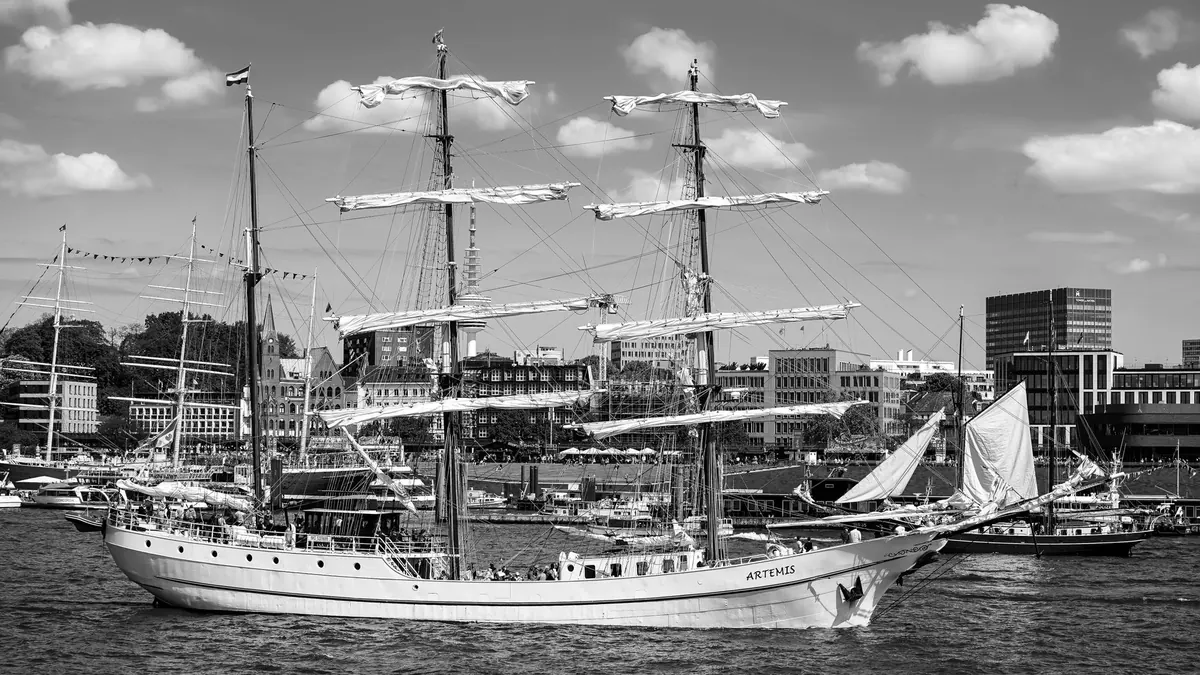
A regatta isn't a show you watch from a deckchair. It's a working harbour doing something unusual with its weekend, and anyone can walk in and join the crowd. Boats race in circles for hours, clubs cook breakfast for hundreds, someone's grandmother wins a tankard she last won in 1979, and the whole place smells faintly of diesel and chips. If you've never been to one, the first visit is mostly about knowing what you're looking at — and knowing where to stand.
What actually happens at a regatta
The racing is easier to follow than it looks. Boats gather near a committee vessel — often a sturdy motorboat flying flags — and classes set off in sequence, a few minutes apart, so the water fills in waves rather than all at once. Each class follows the same course: a windward leg, a mark to round, then a reach or a run back towards the finish line near the club or harbour entrance.
On the water
Some fleets are one-design, meaning every boat is identical and the first across the line wins. Others race under handicap, where different shapes and sizes are given time allowances and the results are worked out afterwards. You'll see everything from dinghies to substantial yachts, and on the west coast of Scotland or in Cornwall, traditional working boats and pilot gigs racing alongside them. A single race usually lasts an hour or two, and a regatta may run two or three races a day over a week.
Racing is at the mercy of the weather. If there's no wind, the fleet sits and waits; if there's too much, the day is abandoned and the bar does unusually good business. Learn to read the postponement flag and you'll understand why nothing is happening.
Ashore
Half the event takes place on dry land. There's a tea tent, a raffle, a results board, a barbecue, a live band on the Saturday night and a prize-giving where people clap politely for boats they've spent the week arguing with. There are children's races, a lifeboat collection, sometimes a church service or a blessing of the fleet. The commercial side matters too: chandlery stalls, a boat jumble, ice cream, and a slightly odd man selling rope offcuts from a van.
The words you'll hear, briefly
- Committee boat — the vessel at the start line, flying the flags that run the racing.
- Windward and leeward — upwind and downwind. Boats sailing towards the wind are closer to it.
- Mark — a buoy that has to be rounded. Most shouting happens here.
- Class — a group of similar boats racing against each other.
- Lay line — the imaginary line a boat steers along to reach a mark without extra tacking.
- Protest — a formal complaint between boats, heard on shore afterwards with flags and paperwork.
- Crew — everyone aboard except the skipper. The people doing the actual work.
Where to watch from
The best free seats are rarely the obvious ones. A headland that looks out over the first beat gives you the whole fleet in one sweep. The end of a harbour wall or breakwater puts you close to mark roundings, though check the tide — nobody wants to be cut off, and nobody wants to be in the way of a rescue boat launching either. Piers, churchyard steps, the upper windows of a pub and the clubhouse balcony all work well.
Do a little homework first. Clubs publish a programme or sailing instructions online, so you can find out when the first start is and roughly which course is being used. Arrive half an hour before the first gun to get a spot and to work out which way the wind is blowing — a flag, a wind sock or a line of moored boats will tell you. Binoculars transform the experience; a camera with a bit of zoom is a close second.
If you want to follow the fleet, look for spectator trips run by local ferries, harbour tour boats or sailing schools. Ring the harbour office or ask at the marina the day before. Even a short trip out to the windward mark and back gives you a view most people on shore never get.
How to join in without a boat of your own
Plenty of people at a regatta are there to work rather than sail, and that's the easiest way in.
- Look for a crew board. Most clubs keep one in the clubhouse, or run a crew-finding group online. Skippers short of hands post there all summer, especially for midweek evening racing.
- Offer yourself for race duties. Regattas run on volunteers: race office, results, galley, mark laying, rescue boat crew, beach marshal, car park. Turn up at the club the evening before and say you're free. You'll be given a job, a mug of tea and a very good view.
- Try gig rowing. Pilot gig clubs in Cornwall, the Isles of Scilly, Wales and beyond take beginners, and the World Championships on Scilly each spring is one of the great sea festivals.
- Book a taster session. Many clubs and sailing schools run open days or beginner sessions in spring. One afternoon in a dinghy teaches you more than a season of watching.
- Ask about social membership. It's usually modest, gets you into the bar, and puts you in the room when skippers are looking for crew.
Sea festivals: the shore-side half
Not every island event revolves around racing. Sea festivals put the boats on display and the town at the centre: gig racing, seafood stalls, shanty singers, a boat jumble, an illuminated procession after dark, fireworks over the harbour, a raft race, a tug of war across the water, a crab-catching competition for children with a bucket and a line of bacon.
These are the easiest events to enjoy as a first-timer, because nothing depends on your understanding of the racing rules. They also tend to be shaped by the ferry timetable — on a small island, the last sailing home dictates when the evening ends, so check it before you settle in for the night.
Kit, manners and a few useful habits
- Layers, a windproof jacket and flat shoes. If you're getting on a boat, wear soft soles that won't mark a deck.
- A soft bag rather than a wheeled case — hard edges scratch gelcoat and varnish.
- Ask before stepping aboard. Once invited, listen to the skipper, keep fingers clear of winches and ropes, and hold a line rather than a finger.
- Don't block a slipway or a rescue boat launch, even for a photograph.
- Take cash. Raffles, cake stalls, collections and the lifeboat bucket don't always take cards.
- If you're crewing, stay to help tidy the boat afterwards. That is how you get asked back next week.
If you're prone to seasickness, speak to a pharmacist before you go rather than experimenting on the day.
Your first regatta: a practical plan
Start with a village regatta rather than the biggest name on the calendar. Smaller events are cheaper, friendlier, easier to walk around and much easier to get a view at. Check the programme in advance and pick the day with the most happening ashore as well as on the water.
Book travel and accommodation early; island ferries fill quickly in summer and often stop running long before the last band finishes. Pack for four seasons in one afternoon. And if the wind doesn't cooperate, don't leave — the shore programme carries on regardless, and that's where the regatta's real character lives.
Turn up, ask a question, and someone will hand you a cup of tea and a job. That's how most people end up coming back every year.
Photo: Wolfgang Weiser / Pexels